

Overview
ZKsync Connect enables interoperability across ZKsync chains in the Elastic Network. Interop, or interoperability, is a way to communicate and transact between two ZK Stack chains, or between a ZK Stack chain and Ethereum L1. It is made possible by smart contracts that verify transactions across chains using Merkle proofs.
It allows you to:
- Observe messages: Track when an interop message (think of it as a special event) is created on the source chain.
- Send assets: Transfer ERC20 tokens and other assets between chains.
- Execute calls: Call a contract on another ZKsync chain or Ethereum L1 with specific calldata and value.
- Execute bundles of calls atomically: Group multiple remote calls into a single bundle, ensuring all of them execute at once.
- Control shadow accounts: Manage smart accounts on other chains, including L1, to execute transactions and manage assets without needing a local account on that chain.
Enhanced user experience
Interoperability enhances the blockchain user experience by abstracting complex cross-chain interactions. Users do not need to manually bridge funds to another chain in the Elastic Network if they already have funds on one.
- Reduced Complexity: Users interact with a seamless interface that hides the underlying complexities of blockchain operations.
- Asset Bridging: Relayers manage the process of bridging assets between chains, handling the necessary burning and minting of assets as they move across the ecosystem.
- Lower Fees: By leveraging efficient relayers and minimizing manual operations, transaction costs are kept low, akin to standard gas fees within a single chain.
Real-World Application: Crosschain Transactions
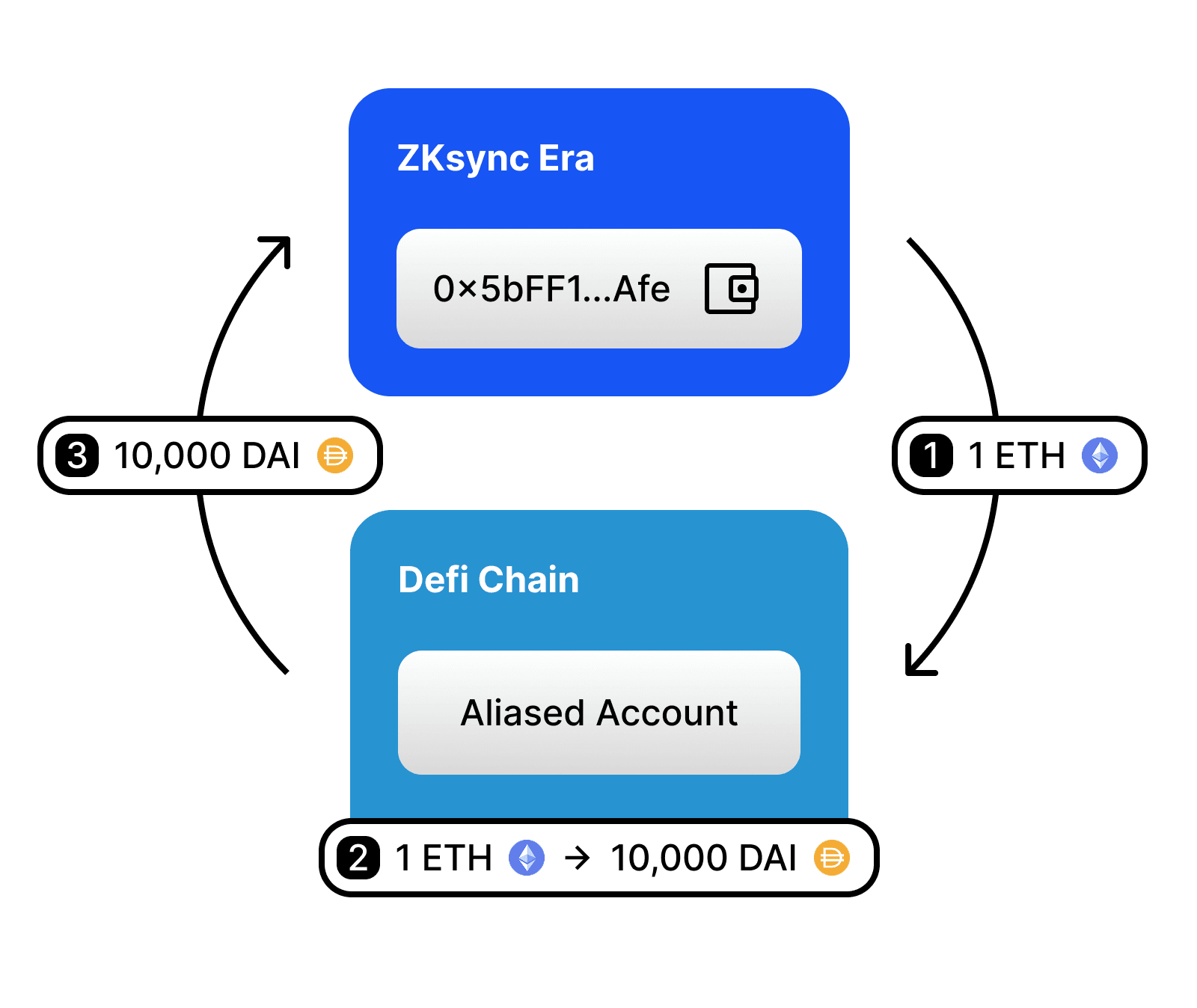
Consider a practical scenario where you want to swap ETH for DAI using a crosschain transaction on a defi platform:
- Transaction Initiation: You initiate the transaction directly from your wallet.
- Relayer Involvement: A relayer picks up your ETH and deposits it into the defi chain.
- Asset Swap: On the defi chain, your ETH is automatically swapped for DAI.
- Completion and Return: The relayer then transfers the DAI back to your original chain.
This entire process is executed as a single transaction, making it feel as seamless as if no chain-switching occurred. The only difference a user might notice is a slightly longer confirmation time, depending on the specific ZKsync chain used.
Transaction Lifecycle
An interop transaction in the Elastic Network follows these steps:
- Initiation: A transaction is initiated on a ZKsync chain, aimed at crossing to another chain within the Elastic Network.
- Settlement on L1: The sending ZKsync chain compiles a cryptographic proof of the transaction and settles it onto Ethereum's Layer 1, anchoring the transaction's validity.
- Interop Root Update: The shared interop/message root gets updated to include the source chain's new message root.
- Root Importation: The receiving ZKsync chain imports this updated interop root through its consensus mechanism.
- Bundle Submission: A relayer submits the bundle together with a message inclusion proof to the receiving ZKsync chain. This proof connects the bundle message to the imported interop root.
- Verification and Execution: The receiving ZKsync chain verifies the bundle message against the interop root. If the verification is successful, the transaction is executed, and the relayer is compensated for their service.
- Proof Settlement: Finally, the receiving ZKsync chain settles its proof on L1, conclusively validating the transaction within the Elastic Network.
Rollout Phases
There are three steps planned for rolling out full interoperability:
- Messaging
- Atomic Asset transfers, and transaction bundles
- Automatic crosschain transactions, L1 interop, and shadow accounts.
Messaging is already available on all ZKsync chains.